Sunday, November 6, 2011

The Impossibility of Doing Good with a Bad Conscience

The secret's out. I saw these signs on  a ride
the day after I stayed up all night writing most of this
It's no secret to anyone who reads my blog or has known me for longer than a few years that I am continually plagued by an uneasy conscience. As one who professes to believe in a Savior who has secured total pardon for all my faults and the never-ending favor of God, occasionally I am awakened to the inconsistency of my guilt and God's faithful grace in spite of my weakness. The past few weeks have been one of those times, as I've gradually perceived a lack of faith in Christ's sufficiency driving my recent reclusive reflection at the expense of more pressing practical priorities. The reason I keep coming back to Reformation theology and its emphasis on justification by faith is that I am by nature and functional conviction not Reformed Protestant, but rather very monkish and religious and worksish, trying to assuage my guilty conscience by things I do and prayers I pray and inward spiritual feelings I attain. Myers-Briggs says the second most common occupation for my personality is a brother in a Roman Catholic religious order. The number one occupation is a sister in such an order. I've been tempted on several occasions.

One of my religious habits is observing Reformation Day, the anniversary of Martin Luther's posting his 95 Theses on the door of the church in Wittenburg, October 31, 1517. For the past few years I've made a habit of pondering particularly Lutheran themes during the month of October, and of watching the movie Luther on or near Halloween, in memory of the two years I focused on such things while teaching Bible to 8th, 9th, and 10th graders. After watching the film again Monday night, and seeing Joseph Fiennes portray Luther's transformation from fear, trembling, and self-loathing introspection to bold, daring, self-sacrificing endeavors for others, I recalled with refreshing poignancy the insight I received while wrestling with the teachings of Jesus, Paul and James, and trying to teach what I saw.

November 1998. Midnight in my dark night of the soul.
Cochran, Ioiel, and beards helped keep me from total insanity. 
Until then, I saw Paul's teaching about justification by grace through faith in Christ and his finished work in confusing tension with Jesus' and James' teaching of justification by words and works, striving to enter by the narrow gate, and that only those who do the will of the Father will be saved, etc. "How can I have confidence that I'm justified now and will finally be declared righteous in the last judgment if that depends on what I do? I understand the idea that the works are the proof of the faith, but I don't see much proof, hard as I try to bear fruit and do good." Ironically enough, it was my evangelical Bible College that seemed to reinforce this absence of peace with all its emphasis on sharing the gospel and "victorious" living, with relatively little attention given to justification. And John Piper's book Future Grace. "The faith that justifies also sanctifies." I love John Piper and agree with this and most of what he says, but that statement killed me. All I could hear in it was "You're not very sanctified, so you're probably not very justified either." For most of the next decade, I sought to prove to myself that I was justified by being sanctified. It didn't work. Downward and inward I went, year after year, with little moments of relief that lasted about as long as my clean-shaven face in college.

Then one day in Autumn 2006, while teaching my fifth period ninth and tenth graders, I mentioned justification by faith as the fulfillment of the blessing promised to Abraham, as Galatians 3 teaches. Jesse Roberts stood up and said "Woohoo! Martin Luther! Justification by faith alone, baby!" To which Dusty Flowe replied "It can't be by faith alone, because then why would we need to be good?" (I might be misquoting Dusty, but it was something to that effect). When I realized there were several students who were troubled by this idea, and that I didn't understand or deeply believe what I claimed to believe, I naturally decided "Yeah! I don't get this at all, so I'll teach fourteen-year-olds about it!" Those two weeks of teaching were some of the hardest days not only of my stint as a teacher, but of my whole life. Parents pulling students out of my class, conferences with parents telling me I was upsetting their children's faith and my biblical exposition was garbage, even administrators telling me to stop teaching on the topic, all compounded by the fact that I lived alone at the time, and interacted with no one outside of teaching. I trembled at the thought they might be right, and that I was causing little ones to stumble. But I refused to leave off the topic; I felt my soul was at stake, and I was determined to resolve the tension I saw without regard for whether it left me Protestant, Catholic, or none of the above. I was also determined to push my students past a simplistic understanding of justification and of the divide between Catholic and Protestant. Through it, I gained the most precious insight into Scripture I've ever seen, and it marked the biggest turning point I've experienced in my ongoing battle with spiritual depression and doubt. Ever since, in the darkest moments of doubt, I find "the mercy seat is open still" and I take refuge in Christ, and not the works of my hands. I think one or two students might have actually picked up on my main points too.

So what's the insight? It's that justification by faith is not only congruent with the necessity of good works for the justification of proven faith (James 2) and a favorable verdict in the final judgment (Matthew 7, 12), it is the necessary foundation for them, the only way by which we may perform such acts of love, mercy, pure speech, and sacrificial obedience. For this reason, I prefer to state the biblical doctrine not as "justification by faith alone", which may be too easily misunderstood as faith that is alone, unaccompanied by other graces, but as "justification by faith only," because in Paul's sense of the word, pardon for sin and peace with God (Romans 3-5), justification is only by faith. There is no work we can do to attain it or secure it, only cast ourselves on the grace of God in Christ and rest in His promised righteousness.

In terms of Scripture, what I sought to understand and reconcile when I was teaching were the apparently contradictory teachings of Paul and James. Here are the key texts:
Paul: "Now to the one who works, his wages are not counted as a gift but as his due. And to the one who does not work but believes in him who justifies the ungodly, his faith is counted as righteousness" (Romans 4:4-5)
"yet we know that a person is not justified by works of the law but through faith in Jesus Christ, so we also have believed in Christ Jesus, in order to be justified by faith in Christ and not by works of the law, because by works of the law no one will be justified." (Galatians 2:16)
James: "You see that a person is justified by works and not by faith alone." (James 2:24)
Some read these and conclude that there were multiple, contradictory Christianities in the first century, and that the teaching of Paul cannot be reconciled with that of James. Without going into all the reasons why I disagree with that stance, let me offer a few thoughts on how James and Paul harmonize with each other beautifully.

A straightforward reading of James and Paul quickly reveals obvious differences in meaning in the three key terms of "faith" (compare Rom 4:18-21 and Gal 2:20 with Jas 2:14, 19), "justification" (Rom 4:6-8; 5:1; cf Jas 2:16, 20), and "works" (Rom 4:9-15; cf Jas 2:15-17). Paul affirms that acquittal and forgiveness before God are received as a gift by trusting in Christ instead of by law adherence, while James denies that we are shown righteous by believing (or saying we believe) in God, while neglecting to obey Him. Most interpreters harmonize the two in this manner, but the question still remains: how does James' teaching that Abraham was justified by works (2:21-24) relate to Paul's teaching that he was justified by faith (Rom 4:1-5)?

The first point to observe is that the two are looking at different events from Abraham's life: Paul speaks of his believing God's promise that he would have a son and his offspring would be as many as the stars (Genesis 15), and James of his offering that son as a sacrifice (Gen 22). Obviously, the event described by Paul happened first, but is there any other textual evidence to suggest that the faith in Paul's mind precedes Abraham's radical obedience expounded by James?

James connects the two episodes by calling the sacrifice of Isaac the fulfillment of Genesis 15:6: "You see that faith was active along with his works, and faith was completed by his works; and the Scripture was fulfilled that says, 'Abraham believed God, and it was counted to him as righteousness'—and he was called a friend of God." (Jas 2:22-23). Abraham's faith in the promise of God became "active" and was "completed" in the sacrifice of Isaac. Genesis describes it as God's "testing" of Abraham (Gen 22:1), an idea which is consistent with the broader teaching of James, who opens his epistle with the well known words "Count it all joy, my brothers, when you meet trials of various kinds, for you know that the testing of your faith produces steadfastness. And let steadfastness have its full effect, that you may be perfect and complete, lacking in nothing."(James 1:2-4). The Greek word translated "trials" (πειρασμοῖς, peirasmoisshares the same root as "tested" in the Greek translation of Genesis 22:1, and the idea of "perfection" is also repeated in James' exposition of the sacrifice (Jas 2:22). So James himself connects his teaching with the focus of Paul's exposition of Abraham's faith.

In what manner then did Abraham's works complete and make active his faith by which he was justified? Did he believe God's promise in order to be counted righteous (Paul's sense of "justified") and then grit his moral teeth to complete his faith with works in order to be proved righteous (James' sense of "justified")? That wouldn't be too unreasonable an assumption, and we might conclude such with only James' teaching to go on. But Scripture tells us "By faith Abraham, when he was tested, offered up Isaac" (Heb 11:17). We might even understand that statement, as I once did, as "Abraham believed he needed to add works to his faith to finally be saved, so he obeyed." Functionally, that's probably where many, if not most, Christians live their daily lives, seeking to add works and obedience to their faith like icing on a cake. But that's not how Abraham obeyed.
Then Abraham said to his young men, “Stay here with the donkey; I and the boy will go over there and worship and come again to you.” And Abraham took the wood of the burnt offering and laid it on Isaac his son. And he took in his hand the fire and the knife. So they went both of them together. And Isaac said to his father Abraham, “My father!” And he said, “Here I am, my son.” He said, “Behold, the fire and the wood, but where is the lamb for a burnt offering?” Abraham said, “God will provide for himself the lamb for a burnt offering, my son.” So they went both of them together. (Genesis 22:5-8)   
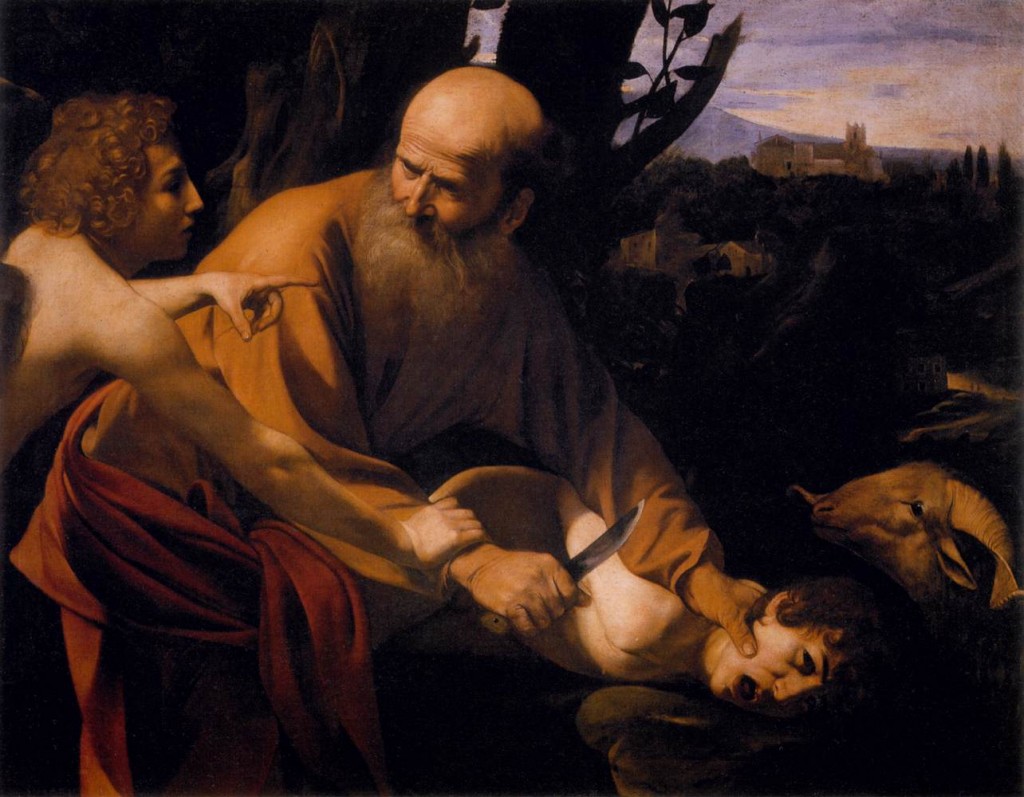
"Abraham and Isaac", Johann Heinrich Ferdinand Olivier
In one of the most agonizing narratives, Abraham expresses his faith explicitly when Isaac asks him where the lamb is for the burnt offering. He believes that "God will provide for himself the lamb for the burnt offering" (v. 8, emphasis mine). Abraham's confidence that Isaac would somehow be delivered is also reflected in verse 5, as he tells his servants that he and Isaac will go worship and return. The letter to the Hebrews reveals another facet of Abraham's confidence, that "God was able even to raise him from the dead, from which, figuratively speaking, he did receive him back" (Hebrews 11:19).

As Abraham performed this most radical, even scandalous, act of sacrificial obedience, he wasn't looking to what he would give God, but rather to what God would give him. He believed two things: God would provide a lamb for himself, and God was able to raise the son of promise from the dead. For those who are familiar with the Christian Scriptures, this foreshadowing of the gospel of Christ almost needs no comment. Belief in provision of a lamb for God anticipates how Christ's sacrifice first provides for God and the demonstration of his righteousness before it can benefit us.
for all have sinned and fall short of the glory of God, and are justified by his grace as a gift, through the redemption that is in Christ Jesus, whom God put forward as a propitiation by his blood, to be received by faith. This was to show God's righteousness, because in his divine forbearance he had passed over former sins. It was to show his righteousness at the present time, so that he might be just and the justifier of the one who has faith in Jesus. (Romans 3:23-26, emphasis mine)
And he believed God would raise Isaac from the dead before he'd let his promise fail. So we are told:
if you confess with your mouth that Jesus is Lord and believe in your heart that God raised him from the dead, you will be saved. For with the heart one believes and is justified, and with the mouth one confesses and is saved. (Romans 10:9-10) 
How was he so bold to believe these things? For one, he had learned through experience that he could have complete confidence in the promise of God. Again and again, God made promises, and Abraham acted in ways inconsistent with those promises, from lying twice about Sarah to protect himself (Genesis 12, 21) to taking her maid in an effort to help God keep his promise (Gen 16). But God kept giving more specific and more amazing promises, until at last He began to fulfill them with the birth of Isaac, when Abraham was 100 years old, and Sarah 90. Through all of it, Abraham had learned that God was on his side, continually pursuing him in grace. Had he been unsure of this, and responded to God's call to offer Isaac as a means to secure God's favor, he would have been paralyzed. But with the passive righteousness of faith, Abraham was able not only to obey, but to comfort both his servants and Isaac through the promised provision of God: "God will provide for himself the lamb for the burnt offering, my son." How gut-wrenching that question must have been to Abraham, and how faithful, truthful, and compassionate was Abraham's answer!
We live in the shade of trees planted by our grandfather in the faith

If Abraham believed in Christ as he was presented to him, in seed form, and had such confidence and willingness to obey, how much more confidence and obedience may we have! In comparison, we have a massive tree of fulfillment in Jesus' incarnation, death, and resurrection, all explained and applied to us with the power and authority of the Spirit. We live in the shade of His tree, where we can see the yes to all of God's promises in Christ (2 Cor 1:19-21; 3:18). It's reasonable then that our call to radical sacrifice is more thorough (Rom 12:1), and the works which we will do far greater (John 14:12).

What are we to do then if we don't perceive the fruit of obedience in our lives? The answer is not "try harder." Rather,
since we have confidence to enter the holy places by the blood of Jesus, by the new and living way that he opened for us... let us draw near with a true heart in full assurance of faith, with our hearts sprinkled clean from an evil conscience... let us consider how to stir up one another to love and good works (Hebrews 10:19-25, emphasis mine)
Trying to justify myself through preaching a promise
I felt I couldn't believe, July 1998
Drawing near to God through Jesus for the cleansing of our conscience must precede and produce any outward works. When we confuse or equate good works with faith, as I've done many times, we don't please God and we don't benefit those around us. Take for example the time I served as a leader on a youth mission trip while burdened with a sense that I would not be saved unless I submitted to God by following fearful compulsions to evangelize strangers. When the mission leaders asked for a volunteer to share a message at an outreach event, I offered, dogged by my evil conscience and the speaker's teaching on responding to the "voice" of God. I failed to realize that the offer was intended for the students, not the leaders, but I was too wrapped up in myself to think about the students. Ironically, the text I shared was one of the most brilliant promises of gospel grace in all of Scripture, but from which I felt completely shut out.

As Luther said, "It is the supreme art of the devil that he can make the law out of the gospel," turning the grace of Christ and the call to believe in him into a meritorious work. But thankfully, "Even the devil is God's devil," as he also said, and "I myself...owe my papists many thanks for so beating, pressing, and frightening me through the devil's raging that they have turned me into a fairly good theologian, driving me to a goal I should never have reached..." (Preface to Luther's Works in German, 1539, emphasis mine). Leave out the "good theologian" part and insert in place of "papists" Keswick theology, John Piper's distillation of Daniel Fuller's doctrinal novelty, Baptist and Catholic parents, Vineyard teaching about the voice of God, and my own conscience, and you've got my story. All of them taught in some form or other a theology of glory, and drove me to the theology of the cross, which is the gospel of Jesus.

So what was the promise I preached without believing? It's perhaps the clearest statement of our confidence as those justified by faith in Christ:
What then shall we say to these things? If God is for us, who can be against us? He who did not spare (ἐφείσατο) his own Son but gave him up for us all, how will he not also with him graciously give us all things? (Romans 8:31-32)
But this is not just a statement of our confidence, but echoes God's word to Abraham as he raised his knife to kill Isaac:
“Do not lay your hand on the boy or do anything to him, for now I know that you fear God, seeing you have not withheld (LXX ἐφείσω) your son, your only son, from me.” (Genesis 22:12)
When I preached the words of Romans, I believed I was offering something valuable to God and saving myself. Ironically, it was that belief which made my offering worthless, for it's only as we're more impressed with God's grace in Christ than we are with our sacrifice that our sacrifice becomes acceptable to God.  Abraham demonstrated this self-forgetful faith when he called the name of that place, 'The LORD will provide'", and so it was said, “On the mount of the LORD it shall be provided (or he shall be seen)” (Genesis 22:14). Whether or not this mount was the location of Jesus' crucifixion geographically, we see here God's provision through Jesus Christ in vivid color. He is the same yesterday, today, and forever, and so in Abraham's sacrifice of Isaac, in my spiritual and theological angst, and wherever God calls his children to be conformed to Christ's sufferings, we may think God is destroying us, but because of the cross, He is actually saving us.

Saturday, October 29, 2011

Writing, Riding, and Contemplation

I've not been riding much, and I've not been writing much. Say that out loud, and unless you have a higher-than-average pronunciation level (say, that of my dad in the 1960s), you'll sound like someone with an advanced case of Alzheimer's. Writing it alerts me to yet another way that these (near)-homophones have become tightly interwoven means of expression for me this year. More accurately, I have been writing much...and deleting, editing, re-organizing, and otherwise second, third, and fourth-guessing myself in just about all of it; since mid-September, I've written fifteen posts (is there a better word for these?) and only published four of them. I've not been riding much; I'll leave that statement unqualified and unedited.

Reaching the goal for 2010
I had a goal to polish up the remaining pieces and publish them here by the end of October. As soon as I set the goal, my creative juices dried up immediately, and I've been greatly frustrated. I have ideas in my head, but can't clothe them with words to save my life. Why can't I write when set my mind to get some writing done? Oddly, it seems cycling works in the opposite fashion; I ride best and have the most surprising adventures and experiences on the bike when I'm aiming for some big goal. Of course, I've set big goals for the past three or four years, so maybe I say that only because I don't remember what it's like just to ride by feel, and not focus my effort on achieving something, even if the thing I seek to achieve lacks any merit beyond my own arbitrary sense of accomplishment. My goals for the past four seasons illustrate this point: 10,000 km in 2008, riding further than I drove in 2009 (failed) and 2010 (achieved, along with 12,000 km), and for 2011, riding every road in York County. Maybe the reason they're different is that riding rewards steady effort, even mindless obsession, while writing does not. To write with a mindset of endurance, pounding out words the way I sometimes pound out miles on the bike, has in my experience led to the kind of dryness I later wish I'd left unwritten: tired cliches, unimaginitive boring words, dumping of information rather than reveling insight. But who knows? Maybe I'm too easily discouraged from the prospect of enduring writing, and too obsessed with numbers and "getting somewhere" to try riding with non-quantifiable aims. Writing endurance and Riding creativity...I think I might try that.

Update: Today as I worked, I realized a commonality between riding toward a big goal and writing by feel, which was my usual habit until my accident-imposed riding hiatus and subsequent writing goal: both of them look to something beyond themselves. That my time off the bike has led to redoubled writing efforts with fractional fruitfulness evaded my notice while writing last night. I'm tempted to say it's as simple as lack of riding equals lack of writing material, but it's not; I've had many ideas I want to put into words, but haven't been able. Oftentimes the best insights and forms of expression burst into my mind while my lungs and legs are bursting on the bike, and I'm presently made painfully aware of my neglect of that outlet, or inlet, I suppose. But cycling functions in my life as more than a means to greater ends such as spiritual contemplation or writing inspiration. I'm inclined to say that it's so tightly connected to these things that it is a living metaphor, even an organic extension of them.

Sunday, October 23, 2011

Filling the World with Endless Books


The Apostle John closes his gospel with these words:
Now there are also many other things that Jesus did. Were every one of them to be written, I suppose that the world itself could not contain the books that would be written. (John 21:25)
I'm increasingly persuaded that this is a conscious allusion to the conclusion of Ecclesiastes:
My son, beware of anything beyond these. Of making many books there is no end, and much study is a weariness of the flesh. (Ecclesiastes 12:12) 
Endless BooksThis gains support from parallels in the contexts of the two verses: compare "Besides being wise, the Preacher also taught the people knowledge" (Eccl 12:9) to "Now there are also many other things that Jesus did" (Jn 21:25), and "This is the disciple . . . who has written these things, and we know that his testimony is true" (Jn 21:24) to "The Preacher sought to find words of delight, and uprightly he wrote words of truth" (Eccl 12:10). And perhaps even "The words of the wise . . . are given by one Shepherd." (Eccl 12:11) with Jesus' threefold re-commissioning of Peter: "Feed my lambs", "Tend my sheep", "Feed my sheep" (Jn 21:15, 16, 17). Unfortunately, I don't have any commentaries on Ecclesiastes in my personal library, and the one I have on John's Gospel (Calvin), doesn't note the allusion. This online commentary mentions it, but doesn't interpret the statement in light of its allusion.

What does the allusion mean? It seems to be a contrast; whereas in Ecclesiastes the endless books are a weariness of the flesh to beware of, the potential endless books that could be written of Jesus' deeds are a source of wonder. Speaking of which, I wonder if the gospel doesn't end this way as a subtle indication that Jesus' followers are, in a sense, those who continue to fill out the endless books with our deeds done in his name. As Jesus said,
“Truly, truly, I say to you, whoever believes in me will also do the works that I do; and greater works than these will he do, because I am going to the Father. Whatever you ask in my name, this I will do, that the Father may be glorified in the Son. If you ask me anything in my name, I will do it. (John 14:12-14, emphasis mine)
 Lots we could explore there about the mystical union of Jesus with his people, and how He is the one at work in us to do His works, and even to fill the whole world with them. There seems to be some suggestion of this in Paul's teaching that believers themselves are a letter from Christ addressed to the whole world (2 Cor 3:2-3), a poem (Gk. poiema) written by God to artfully express His goodness to the world (Eph 2:10).

I think that might be an even more profound truth than what I originally intended to write, that in Christ, the study of books is transformed from an exercise in futility into a life-giving pursuit. I say this because study is not the only thing Ecclesiastes speaks of as a "weariness": "All things are full of weariness; a man cannot utter it..." (Eccl 1:8, emphasis mine). Whatever interpretive approach one takes to the book, it is clear that its perspective on some things is incomplete, that some of its ideas are transformed through the gospel of Jesus. For example, the contrast between "work hard because you'll die someday and not be able to work anymore" (Eccl 9:10) and "work hard because Christ has triumphed over death and you'll be raised too" (1 Cor 15:50-58).

In any case, here's a quote from Martin Luther on the subject:
"There never yet have been, nor are there now, too many good books." -Preface to W. Link's Annotations on the Pentateuch 
This contradicts Ecclesiastes 12:12 rather bluntly, but is spoken by a man who truly found new life in Christ through study of the good book. Here's another reflection, based on the text from John 21 quoted above, from historian Mark Noll:
Noll at Study
What is true for the life and work of Christ in general is also true for the life of the mind. If the meaning of what Jesus did and is exceeds the capacity of all the books that could be written, so too the meaning of what Jesus did and is, with respect only to the intellectual life, exceeds the capacity of all the books that could ever be written. Christian believers who realize that it is impossible ever to fathom the depths of wisdom and knowledge hidden in Jesus Christ nonetheless know that the proper place to begin serious intellectual labor is the same place where we begin all other serious human enterprises. That place is the heart of our religion, which is the revelation of God in Jesus Christ. (Introduction to Jesus Christ and the Life of the Mind, Erdmans, 2011, xii, emphasis mine)
I was thrilled to find a thinker as well-respected as Noll saying almost the same thing I was, even if he didn't base it on the allusion I propose. I am intrigued though by the second sentence; why does he make that conclusion about the intellectual life? I'm off to more reading, and hopefully I'll report back with a good answer.

Tuesday, October 11, 2011

The Rough Places Plain

Continuing the theme of God's word coming through strange means, here's a familiar text set to familiar (to some) music presented in a most unusual way:


Wow. I'm pretty sure that doesn't live up to its own lyric "Speak ye comfortably..."

This text and its theme of straight paths have been brought to my mind repeatedly in the past two months or so, not the least by my cycling experiences. My first long ride after the crash set them before me once again. On Friday, September 30, Will Thompson and I rode south of Rock Hill to the place where I crashed on Strait Rd. Here's what we found:
The hole that caused my crash was filled in
 I don't know if my accident had anything to do with the filling of the hole; it's possible, because the man who gave Robert and me a ride back to town said he'd been requesting the repair for a while and that the hole had almost caused a car accident (whether for him or someone he knew I don't recall). Either way, I was reminded of the words of Isaiah, "The uneven ground shall become level, and the rough places a plain" (Isaiah 40:4). Did Isaiah work in earth removal on a highway crew? Probably not, but his use of natural imagery suggests he probably spent a good deal of time outdoors.

What does this phrase mean, then? The context speaks of the Lord's comforting His people, forgiving the sins of Jerusalem, and revealing his glory to all flesh (Isaiah 40:1-2, 5). Isaiah 35 also connects the renewal of the wilderness with the revelation of the glory of the Lord and a "highway of holiness" for the redeemed to travel, with the added promise of healing for the blind, deaf, lame, and mute (Is 35:1-2, 5-6, 8-10). Isaiah 51 shares similar themes, echoing ch. 35 and its promise of God's redeemed people returning to Zion (Is 51:11; cf. 35:10), and tellingly speaks of "waste places," "wilderness," and "desert" as aspects of Zion which God will "comfort" (Is 51:3). This suggests that the geographical imagery in these texts is to be understood at least in part (it may have multiple senses, as the prophets often do) as referring to moral or spiritual qualities God sees in people's hearts and lives.

What kind of lives are like deserts and rough ground? Luke gives us confirmation as well as some guidance in this interpretation in applying this text to John the Baptist
the word of God came to John the son of Zechariah in the wilderness. And he went into all the region around the Jordan, proclaiming a baptism of repentance for the forgiveness of sins. As it is written in the book of the words of Isaiah the prophet,
“The voice of one crying in the wilderness:
‘Prepare the way of the Lord,
make his paths straight.
Every valley shall be filled,
and every mountain and hill shall be made low,
and the crooked shall become straight,
and the rough places shall become level ways,
and all flesh shall see the salvation of God.’”
St. John the Baptist Preaching in the Wilderness, Pieter Bruegel the Younger
He said therefore to the crowds that came out to be baptized by him, “You brood of vipers! Who warned you to flee from the wrath to come? Bear fruits in keeping with repentance. And do not begin to say to yourselves, ‘We have Abraham as our father.’ For I tell you, God is able from these stones to raise up children for Abraham. Even now the axe is laid to the root of the trees. Every tree therefore that does not bear good fruit is cut down and thrown into the fire.” (Luke 3:2-9, emphasis mine)
John's exhortation in the desert of Jordan to the people to repent and be baptized for forgiveness fulfills Isaiah's prophecy of a voice crying in the wilderness, and his instruction of how they should live, having repented, corresponds to the call to prepare the way of the Lord. That so many people heard and responded to John's message (cf Mark 1:5) seems to be the fulfillment of the promise of filled valleys, lowered mountains, straightened crooks, and leveled roughs. Or perhaps a fulfillment of the promise: the threatened judgment against the people's self-righteousness, spoken of as God "raising up" children of Abraham from stones and "cutting down" trees that don't bear fruit echoes the lowering and raising language of Isaiah.

This theme of "turning things upside down" continues as the kingdom of God arrives and advances in the person of Jesus and his words and deeds. So many of Jesus' teachings fit this pattern: the meek inherit the earth (Matthew 5:5), the one who exalts himself is humbled (Luke 18:14), and the one who seeks to save his life will lose it (Luke 9:24). Even the ongoing ministry of the apostles after Jesus' ascension is spoken of as "men who have turned the world upside down" (Acts 17:6). 

But perhaps Jesus' greatest work of leveling was his humiliation, suffering, and death. In these he walked through our uneven ground and rough places, indeed the "harshest terrain" any of us ever face in this life, and by walking in them, He made them smooth.
  • he became poor so that we through his poverty might become rich (2 Corinthians 8:9)
  • he was rejected by his own people (Is 53:3; Jn 1:11), so that we who receive him might be received as his people (Jn 1:12; Rom 5:1-2; 9:25-26)
  • he learned obedience through his suffering (Heb 5:8) so that we might experience suffering as the Father's loving discipline that makes us holy and leads to glory (Heb 12:3-14; Rom 8:16-18)
  • he became sin, that in him we might become the righteousness of God (2 Corinthians 5:21)
  • he died to destroy the devil who had the power of death and free us from our fear-of-death-induced lifelong slavery (Heb 2:14-15)
This last point is one to dwell on; I don't think we listen carefully, let alone believe, the amazing things the New Testament says about the transformation of death through Jesus. This was brought to my attention this week by the comment from Steve Jobs in his 2005 commencement speech at Stanford that "no one wants to die; even people who want to go to heaven don't want to die to get there." Hmm. I may be speaking defensively of my beliefs as a Christian, but I don't think he's quite right. Paul wrote to the Philippians some of the most amazing words ever expressed by a person about death,
it is my eager expectation and hope that I will not be at all ashamed, but that with full courage now as always Christ will be honored in my body, whether by life or by death. For to me to live is Christ, and to die is gain. If I am to live in the flesh, that means fruitful labor for me. Yet which I shall choose I cannot tell. I am hard pressed between the two. My desire is to depart and be with Christ, for that is far better. But to remain in the flesh is more necessary on your account. Convinced of this, I know that I will remain and continue with you all, for your progress and joy in the faith, (Philippians 1:20-25)
Paraphrase: "I don't care whether I live or die as long as Christ is glorified." The telling feature of this passage is that Paul speaks precisely the way someone speaks who is torn between two options: can't you hear someone speaking this way about which job to take, or where to go out to eat, or what bike to buy? "I can't decide; I'm hard pressed between them. I want to do this, but it would be better for them if I do that."

Paul, Archiepiscopal oratory of St. Andrew in Ravenna, Italy, late 5th century
Some would say Paul had lost his mind, to which he replies "I am not out of my mind . . . but I am speaking true and rational words" (Acts 26:25). Paul wrote more of the New Testament than any other human author, and is regarded as the most influential theologian (behind Jesus himself) in the history of Christianity; much of his moral teaching is regarded by people of all faiths as sublime; and his depth of insight into human nature and Scripture stretches the minds of the most brilliant scholars. He's not a lunatic. Rather, he had seen the risen Christ, and was so convinced that Jesus was risen that he said Christians were pitiable fools if he wasn't raised (1 Cor 15:12-19). But he also experienced more deeply than most the life-transforming power of the Holy Spirit, whom Jesus himself promises to give to those who ask for him (Lk 11:13). The Spirit is the Lord and giver of life who mediates Jesus' personal presence and gives assurance of regeneration and such confidence in Jesus' resurrection and our share in it that the heaviest burden of suffering becomes light in comparison to the eternal weight of glory it produces (2 Cor 4:17). Not only did Paul desire to depart and be with Christ, but he wanted to suffer for him and with him:
Indeed, I count everything as loss because of the surpassing worth of knowing Christ Jesus my Lord. For his sake I have suffered the loss of all things and count them as rubbish, in order that I may gain Christ . . . and may share his sufferings, becoming like him in his death, that by any means possible I may attain the resurrection from the dead. (Philippians 3:8, 10-11)
 Now I rejoice in my sufferings for your sake, and in my flesh I am filling up what is lacking in Christ's afflictions for the sake of his body, that is, the church. (Col 1:24)
Paul's willingness, even desire, for suffering and death sound shockingly morbid to us, but in these statements, he's not suicidal or morbid, but rather exuberant and hopeful, out of love for Christ. The Spirit of God had sealed to his heart the full depth of Christ's death-defying death and these truths he wrote and God speaks to us:
  • "the sufferings of this present time are not worth comparing with the glory that is to be revealed to us." (Rom 8:18) 
  • "Christ Jesus is the one who died—more than that, who was raised—who is at the right hand of God, who indeed is interceding for us. Who shall separate us from the love of Christ? Shall tribulation, or distress, or persecution, or famine, or nakedness, or danger, or sword? No, in all these things we are more than conquerors through him who loved us." (Rom 8:34-35)
  • "For I am sure that neither death nor life, nor angels nor rulers, nor things present nor things to come, nor powers, nor height nor depth, nor anything else in all creation, will be able to separate us from the love of God in Christ Jesus our Lord." (Romans 8:28-39)
  • "For all things are yours, whether Paul or Apollos or Cephas or the world or life or death or the present or the future—all are yours, and you are Christ's, and Christ is God's. (1 Cor 3:21-23)
  • Death is swallowed up in victory.” “O death, where is your victory? O death, where is your sting?” (1 Cor 15:51-55)
  • Those who have died in Christ are "asleep." (John 11:11 1 Cor 15:18; 1 Thess 4:13-15)
Like parents describing thunder as God rolling strikes in his heavenly bowling alley, Jesus and his apostles almost jokingly describe death like an afternoon nap; one day, Jesus will say to all of those who are part of his bride, "Honey, wake up" (Mk 5:41).

To believe Jesus' power over death is nothing less than to see the glory of God, as Jesus said, “Did I not tell you that if you believed you would see the glory of God?” (John 11:40, cf 11:4, 25-26) That our original text from Isaiah 40 also connects the leveling of uneven ground with the revelation of God's glory suggests that this interpretation is on the right track:
 Every valley shall be lifted up,
and every mountain and hill be made low;
the uneven ground shall become level,
and the rough places a plain.
And the glory of the LORD shall be revealed,
and all flesh shall see it together,
for the mouth of the LORD has spoken.” (Isaiah 40:4-5) 
Isaiah's next words also support this:
All flesh is grass,
and all its beauty is like the flower of the field.

The grass withers, the flower fades,
but the word of our God will stand forever. (Isaiah 40:6b, 8) 
In light of this, John's familiar words come into sharper relief: "And the Word became flesh and dwelt among us, and we have seen his glory, glory as of the only Son from the Father, full of grace and truth." (John 1:14). This is how we see the glory of the Lord in brightest color, that the eternal Word of God (Jn 1:1; Is 40:8), the second person of the Trinity, became flesh and was even cut down like grass, but was raised back to life, so that through him we might stand forever (cf Jn 12:23-24).

In the spirit of divine beauty expressed in an outwardly unattractive form, here's Schprockets meets Handel. The style is odd; the singing impeccable.

Monday, October 3, 2011

"God once spoke through the mouth of an ass..."

It's October! Time to bust out the monk robe, bury myself in some books, pour pumpkin into my pancakes, and maybe even throw back a beer or two. And read some of this guy:
"(God) once spoke through the mouth of an ass (Num 22:28); therefore, no man is to be despised, however humble he may be. On the other hand, He permitted the highest angel to fall from heaven; therefore, no man is to be trusted, no matter how wise, holy, or great he may be. One should rather give a hearing to all, and wait to see through which one of them God will speak and act." -Martin Luther in Temporal Authority: To What Extent it Should be Obeyed  
I mention this quote for more than shock value; my recent cycling experiences have reminded me of God's opening the mouth of Balaam's donkey in Numbers 22. Balak, King of Moab, summoned Balaam the prophet to curse Israel; after initially denying him permission, God let him go, but warned him "only do what I tell you" (Num 22:20). Here's the pivotal part of the story:
But God's anger was kindled because he went, and the angel of the LORD took his stand in the way as his adversary. Now he was riding on the donkey, and his two servants were with him. And the donkey saw the angel of the LORD standing in the road, with a drawn sword in his hand. And the donkey turned aside out of the road and went into the field. And Balaam struck the donkey, to turn her into the road. Then the angel of the LORD stood in a narrow path between the vineyards, with a wall on either side. And when the donkey saw the angel of the LORD, she pushed against the wall and pressed Balaam's foot against the wall. So he struck her again. Then the angel of the LORD went ahead and stood in a narrow place, where there was no way to turn either to the right or to the left. When the donkey saw the angel of the LORD, she lay down under Balaam. And Balaam's anger was kindled, and he struck the donkey with his staff. Then the LORD opened the mouth of the donkey, and she said to Balaam, “What have I done to you, that you have struck me these three times?” And Balaam said to the donkey, “Because you have made a fool of me. I wish I had a sword in my hand, for then I would kill you.” And the donkey said to Balaam, “Am I not your donkey, on which you have ridden all your life long to this day? Is it my habit to treat you this way?” And he said, “No.”
The Angel Appearing to Balaam, Gustave Dore
Then the LORD opened the eyes of Balaam, and he saw the angel of the LORD standing in the way, with his drawn sword in his hand. And he bowed down and fell on his face. And the angel of the LORD said to him, “Why have you struck your donkey these three times? Behold, I have come out to oppose you because your way is perverse before me. The donkey saw me and turned aside before me these three times. If she had not turned aside from me, surely just now I would have killed you and let her live.” Then Balaam said to the angel of the LORD, “I have sinned, for I did not know that you stood in the road against me. Now therefore, if it is evil in your sight, I will turn back.” And the angel of the LORD said to Balaam, “Go with the men, but speak only the word that I tell you.” So Balaam went on with the princes of Balak. (Numbers 22:22-35, emphasis mine)
I can imagine my bike saying to me, "Am I not your bike, on which you have ridden all your life to this day? Is it my habit to treat you this way?" To which I echo Balaam's answer "No." That's my story, besides some donkeyishly stubborn chronic wheel problems and a few broken parts from riding too hard. Before August, the worst damage a wreck had caused me was a bent rim; and I'd not been to the emergency room since sixth grade. That's more than 20 years and probably 40,000+ miles of riding. Then in one month I have two accidents that crack my frame and put me in the hospital, albeit only for a few hours, thankfully.

Not only that, but my cumulative bike woes this summer have gradually opened my eyes to the מַלְאַ֤ךְ יְהוָה֙ (malak Yahweh, lit. "messenger of Yahweh") standing in my way, with his drawn sword in his hand. No, I've not had visions of angels and I'm not losing my mind, at least not any more than usual. The "angel of the LORD" in the Old Testament is commonly viewed by Christian interpreters as a pre-incarnate appearance of the God the Son; one reason is that texts where he appears often comingle this title with simply "the LORD" (e.g., Gen 16:7-13; 22:15f.). Here, the angel of the LORD assumes divine prerogatives in giving Balaam similar commands as God (Num 22:20, 35, 38) and carrying out God's will (Num 22:22). I've come to perceive that Christ is opposing me in my way, and the sword He wields is not one for cutting off my limbs, but sharp enough to pierce my very soul and judge the thoughts and intentions of my heart (Heb 4:12; Luke 2:35).

What is he saying? I've noted before how God seems to be providentially bringing my attention back to several texts dealing with themes of His fatherly discipline and straight paths. I've been seeking to give heed to the exhortation to "make straight paths for your feet" (see Heb 12:12-13), often praying "Make me to know your ways, O LORD; teach me your paths" (see Ps 25:4-5), and He's answered "All the paths of the LORD are steadfast love and faithfulness" (Ps 25:10) and "Let your eyes look directly forward . . . Do not swerve to the right or to the left; turn your foot away from evil" (see Prov 4:25-27) and "let us run with endurance the race that is set before us, looking to Jesus" (Heb 12:1-2). The insight that's helped me most is that the root idea of the Hebrew words translated "ways" and "paths" in these texts isn't so much concerned with going somewhere new as it is with habit, manner of life, custom, which is what paths really are: they're places people customarily travel. I get so obsessed with riding, with knocking out particular sections of roads, with getting "done" with my goal, that I let more important things slide, and this choice of priority quickly becomes a habit, even an addiction, and it's not good. I don't set out to, but I end up neglecting sleep, eating the same thing day after day, letting the house and yard go, riding too many loner cul-de-sac ventures and no club rides, slacking off in work responsibilities, not to mention my neglect of spiritual disciplines of prayer, reading Scripture, and fellowship with God's people. In terms of Balaam's story, "I have come out to oppose you because your way is perverse before me" ( כִּֽי־יָרַ֥ט הַדֶּ֖רֶךְ לְנֶגְדִּֽי, lit. "for the way precipitates (falls headlong with violent speed) in front of me") (Num 22:32). 

I wrote several times over the summer that I found some of the Proverbs particularly challenging regarding these same ideas, but though I noted them, I didn't change my course. The riding was still the priority; everything else took a back seat. But thanks be to God that he instructs sinners in the way (Ps 25:8), that the same God who sought out Adam in the garden, asking gently "Where are you?" (Gen 3:8-9) and came down to oppose Balaam, also came to seek and save the lost (Lk 19:10). He came to me in such grace: not only did He get my attention through the very things that were turning my gaze away from Him, but He brought specific teachings of His word to mind that spoke in terms of ways, paths, and running with endurance, i.e., the very things that were distracting me. All of this to call me to run (or ride, as I like to think) with endurance in the straight paths He's set before me, to set my heart on the highways that really lead to life and beauty and meaning and purpose. He truly is Immanuel, God with us.

In the three weeks I went without riding other than a commute, my sentiment regarding riding every road in the county was like Balaam's "if it is evil in your sight, I will turn back" (Num 22:34). I was prepared to completely abandon the endeavor, but I think instead of that, God would have me proceed in the spirit of verse 35, "Go with the men, but speak only the word that I tell you" (cf. Num 22:20). I'm challenged by that to be more careful in what I write, to handle Scripture more faithfully, and not recklessly assume my zen-like insights are all true and worth spreading abroad. In the larger context of Balaam's situation, that meant speaking a word of blessing over the people of Israel instead of cursing, and that in keeping with the seminal promise God made to Abra(ha)m in Genesis 12:2-3, "I will make of you a great nation, and I will bless you and make your name great . . . I will bless those who bless you, and him who dishonors you I will curse." I've been thinking for several months of how I might make the riding itself into more of a benefit to other people rather than just a way to stroke my cycling ego and gratify my urge to study maps. I want to use it to make a map of the county that classifies roads by bikeability and notes obstacles, hazards, and sites of interest to cyclists. It's time to take action on that. I'd even love for it to develop into a website that has a dynamic system of rating the roads, since they do change over time, and this endeavor to ride them all is going to take more time than originally thought as well.

I've been back on the bike twice this weekend, and I'm continuing to see God's hand in it all. More on that next time.


Friday, September 30, 2011

The Shadow of a Great Rock in a Dry and Weary Law

I've been seeing more correlation between special revelation and general revelation lately. Here's one example.

Psalm 19 speaks of the glory of God revealed in the skies, and in a second section, of the perfections of God's law. Here's the first section:
The heavens declare the glory of God,
and the sky above proclaims his handiwork.
Day to day pours out speech,
and night to night reveals knowledge.
There is no speech, nor are there words,
whose voice is not heard.
Their voice goes out through all the earth,
and their words to the end of the world.
In them he has set a tent for the sun,
which comes out like a bridegroom leaving his chamber,
and, like a strong man, runs its course with joy.
Its rising is from the end of the heavens,
and its circuit to the end of them,
and there is nothing hidden from its heat.
(Psalm 19:1-6 ESV)
Though we often think of the nighttime sky when we think of "the heavens" revealing the nature of God, here David focuses on the daytime sky, and particularly the sun. If you've been to Israel (or any desert, for that matter), you'll understand the attention given to the daytime sun: the clean dry air makes the night sky breathtakingly beautiful, but the daytime sun shows the כְּבֹֽוד־אֵ֑ל, the glory, heaviness, splendor, and copiousness of God. When I was there ten years ago, the dryer where we stayed broke, but it didn't matter (besides a little embarrassment at everyone seeing each other's underwear), because clothes dried faster in the sun than they did in the dryer. And this is exactly the conclusion reached by the Psalm regarding the sun in verse 6: "there is nothing hidden from its heat." 


Speaking of embarrassment, I've often felt it when looking back at pictures of the trip, all of which show me wearing this goofy safari hat, helpful as it was in the glorious desert sun:
Mt. Arbel 1200 feet above the Sea of Galilee. The wind almost blew me off into oblivion. 


Back on topic then, the second half of the Psalm:
The law of the LORD is perfect,
reviving the soul;
the testimony of the LORD is sure,
making wise the simple;
the precepts of the LORD are right,
rejoicing the heart;
the commandment of the LORD is pure,
enlightening the eyes;
the fear of the LORD is clean,
enduring forever;
the rules of the LORD are true,
and righteous altogether.
More to be desired are they than gold,
even much fine gold;
sweeter also than honey
and drippings of the honeycomb.
Moreover, by them is your servant warned;
in keeping them there is great reward.
(Psalm 19:7-11)
I love this Psalm, though I've often wondered how the two halves relate to each other. Recently I saw a connection between the meditation on the glory of God revealed in the skies, and the moral perfection revealed in the law. The Psalm continues:
Who can discern his errors?
Declare me innocent from hidden faults.
Keep back your servant also from presumptuous sins;
let them not have dominion over me!
Then I shall be blameless,
and innocent of great transgression.
(Psalm 19:12-13)
Do you see it? The conclusion of the section about the glory of God shining in the sun is "there is nothing hidden (נִ֝סְתָּ֗ר ) from its heat" and the conclusion of the teaching on the law includes the prayer "Declare me innocent from hidden (מִֽנִּסְתָּרֹ֥ות) faults" (the Hebrew word is compound for "from hiddens", if I may create an English word; the English "faults" is merely implied). Because God's perfect law demands obedience, it wakes us up and brings us to realize our failure, our errors, our hidden faults, and that the path to blamelessness (אֵיתָ֑ם eytam; cf. v. 7 תְּ֭מִימָה temiymah) is not in our ability, but in God's gracious intervention. He alone can declare us innocent, keep us back from presumptuous sins, and deliver us from their dominion.

In his conclusion to the Psalm, David prays:
Let the words of my mouth and the meditation of my heart
be acceptable in your sight,
O LORD, my rock and my redeemer.
(Psalm 19:14)
While the "law" half of the Psalm brings us to the LORD as redeemer, what of the title "my rock"? The attention given to the sun as revelator of God's glory and similar to a bridegroom and champion warrior fits with Scriptural metaphors that describe God (Psalm 84:11; Isaiah 54:5; 62:5; Psalm 78:65; Zephaniah 3:17). So why not "my sun and my redeemer" in v. 14?

In Scripture a rock is a symbol of strength and perfection (Deuteronomy 32:4, 15; "rock" is used seven times in that chapter), a source of water in the desert (Isaiah 48:21; Exodus 17:6; Numbers 20:11; Psalm 78:16, 20), and a place of refuge from an enemy (most of the 28 occurrences in the Psalms). Amazingly, in the closest encounter with God of all the Old Testament prophets, a rock serves Moses as the place of protection from God himself (Exodus 33:18-23). Why does Moses need protection from God? Because, as God says, "'you cannot see my face, for man shall not see me and live'"(Exodus 33:20). The immediate holiness and glory of God are literally more than a human can bear. Is this not exactly what the sun "says" in its shining every day? The sun is a lethal danger to our vision, our skin, and if we're over-exposed to its heat, to our overall vitality.

Might it be that just as we need protection from the sun's heat and light, so we need protection from the law of God, not because they are in and of themselves destructive, but because we are so frail that we cannot bear their brilliance? Maybe the giving of the law in the desert was more than a geographical and historical accident, but was rooted deeply in God's wisdom, to flavor the entire law with sun-baked dryness that impels our longing for shady waters. Where is the shade at the end of the legal wilderness? Isaiah foreshadows the relief when he compares a future king and his princes to
a hiding place from the wind,
a shelter from the storm,
like streams of water in a dry place,
like the shade of a great rock in a weary land. (Isaiah 32:2)
Who are the king and the princes, and how do they give this shelter and shade? That will have to wait for another post, but for now, let's listen to God speaking through Isaiah once again:

“Come, everyone who thirsts,
come to the waters;
and he who has no money,
come, buy and eat!
Come, buy wine and milk
without money and without price.
Why do you spend your money for that which is not bread,
and your labor for that which does not satisfy?
Listen diligently to me, and eat what is good,
and delight yourselves in rich food.
Incline your ear, and come to me;
hear, that your soul may live;
and I will make with you an everlasting covenant,
my steadfast, sure love for David.
(Isaiah 55:1-3, emphasis mine)


Thursday, September 15, 2011

Beautiful Feet

While doing my laundry tonight I realized another reminder of Hebrews 12 from my ride and crash Saturday. I was wearing these socks:
Adam Little
They say "Run with Endurance the race marked out for you". They were made in memory of Adam Little, who was tragically killed while riding to work in Charlotte last year. He was a believer, and like Abel, "through his faith, though he died, he still speaks" (Hebrews 11:4). I didn't know him, but after his death the local cycling community was grief-stricken; he was loved by all who knew him.

I see all this, and connect the dots, but my heart faints. God has answered my prayer this week to show me my crooked ways that need to be made straight, and that has hurt and humbled me, but I feel weak and lazy and my heart is distracted with temporal things and dispassionate toward the invisible things of God.


Hear my cry, O God,
listen to my prayer;
from the end of the earth I call to you
when my heart is faint.
Lead me to the rock
that is higher than I,
for you have been my refuge,
a strong tower against the enemy. (Psalm 61:1-3)